Are you trying to decide between eToro and Bybit but not sure how they compare? We have analysed both platforms across various factors including trading fees, security measures, product offerings, trading fees and much and more. Read on to find out which platform makes most sense for you to use!
eToro and Bybit are two very different cryptocurrency exchanges with unique features that cater to different types of users. Let's begin by breaking down the basics of both exchanges.
eToro was founded in 2007 by Yoni & Ronen Assia and is a global social trading and multi-asset investment platform that enables users to trade a range of financial instruments, including cryptocurrencies.
eToro exchange
eToro has gained popularity for its user-friendly interface, diverse range of assets, and innovative social trading features. The platform allows users to follow and copy the trades of experienced investors, creating a community-driven trading experience. With a user base of 30 million users worldwide, eToro has over 10 million downloads on its app with a 4-star rating based on over 100,000 reviews.
eToro app
Bybit was founded much later than eToro (in 2018) by Ben Zhou and is a rapidly growing cryptocurrency derivatives exchange known for offering advanced trading options, including perpetual contracts, futures, and inverse contracts, with up to 100x leverage for various cryptocurrencies such as Bitcoin, Ethereum, and more.
Bybit exchange
The platform is committed to delivering a seamless trading experience through its high-speed matching engine, allowing for minimal downtime and slippage. With a user base of over 10 million users mainly based in Europe and Asia, Bybit is also available as an IOS and Android app and has over 5 million app downloads and an impressive 4.2-star rating with over 60,000 reviews. Bybit offers a selection of 250 cryptocurrencies to buy, sell, trade in addition to stake and earn.
Bybit app
While eToro is a better fit for casual investors who want exposure to a wide range of financial products in a one stop shop, Bybit is the more comprehensive cryptocurrency exchange tailored to more experienced traders.
eToro vs Bybit Signup & KYC
If you're looking for a platform to trade cryptocurrencies, you'll need to make sure you're familiar with the signup process and KYC requirements of each exchange.
To start with, eToro requires KYC verification for all trading on their platform. Creating an account is quick and easy taking only a minute to enter your username, email, and confirm your email verification. Once you've entered your personal information and provided a valid government ID, eToro will take up to 1-2 business days to process and verify your account.
eToro KYC
Contrary to eToro, Bybit allows for trading without KYC verification but with some limitations such as a daily withdrawal limit of 20K USDT and a monthly limit of 100K USDT. For those that want to participate in Bybit's earn, one click buys and conduct fiat deposits, KYC verification is required.
Bybit signup
The signup process for Bybit is also easy with users being able to register with their phone number or email. The KYC verification process on Bybit takes approximately 10 minutes to be verified by Bybit but can take up to 48 hours in some cases. We give the edge to the signup process to Bybit because of the non-obligatory KYC requirements. This means that users can more easily signup, deposit cryptocurrencies and beginning trading right away.
eToro vs Bybit Products & Services
eToro is a versatile platform that allows users to buy and sell a wide range of financial assets, including 80 cryptocurrencies like Bitcoin and Ethereum. However, eToro does not offer any spot trading via a traditional orderbook like most other exchanges. Besides cryptocurrencies, eToro has created a platform that provides users with a wide choice of more traditional financial products such as stocks, indices, commodities, currencies, ETFs and even NFTs.
eToro products and services
This makes eToro a great one stop shop for those that want exposure beyond just cryptocurrencies such as Bitcoin and Ethereum. In terms of the user experience, there is great convenience in having so many financial assets under one rough. Having said that, the interface on eToro does feel a bit outdated and could do with a refresh and simplification.
On the other hand, Bybit is a comprehensive cryptocurrency platform that offers spot trading, futures, margin trading, perpetual swaps (perps), options, and leveraged tokens.
Bybit spot trading
Bybit offers perpetual contracts using USDC and USDT as collateral in addition to inverse perpetual futures and USDC options.
Bybit also offers trading bots, which can help users automate their trading strategies. The platform features copy trading which let's users replicate the trades of successful traders.
Bybit copy trading
Bybit also includes financial services like lending and borrowing, an NFT marketplace where users can buy and sell NFTs, and the Bybit card which lets users spend their digital assets in everyday transactions.
Bybit's earn products
Bybit offers a great user experience with loads of trading products that will satisfy the needs of professional traders. The interface is very cleverly designed and easy to navigate even for beginners.
Bybit NFTs
In terms of liquidity, Bybit is in the top 10 category with daily spot trading volumes frequently exceeding $1 billion. The max futures leverage available on Bybit is 100X while margin trading is available with up to 5X leverage with USDC, USDT, BTC and DAI as underlying collateral.
Overall, while eToro is more focused on offering a wide range of financial traditional assets to beginners and investors, Bybit stands out for its comprehensive cryptocurrency trading services, user-friendly interface and additional retail products such as card, NFTs, launchpad, earn products and more.
Now that we have seen that product offering of each exchange, let's see what they charge as well.
eToro charges a flat 1% fee for those who wish to buy and sell cryptocurrencies on their platform. eToro does not offer any rebates for higher trading volumes and everyone pay the same fee for each trade. When it comes to products such as stocks, eToro offers it's users the option to buy and sell with a 0% commission.
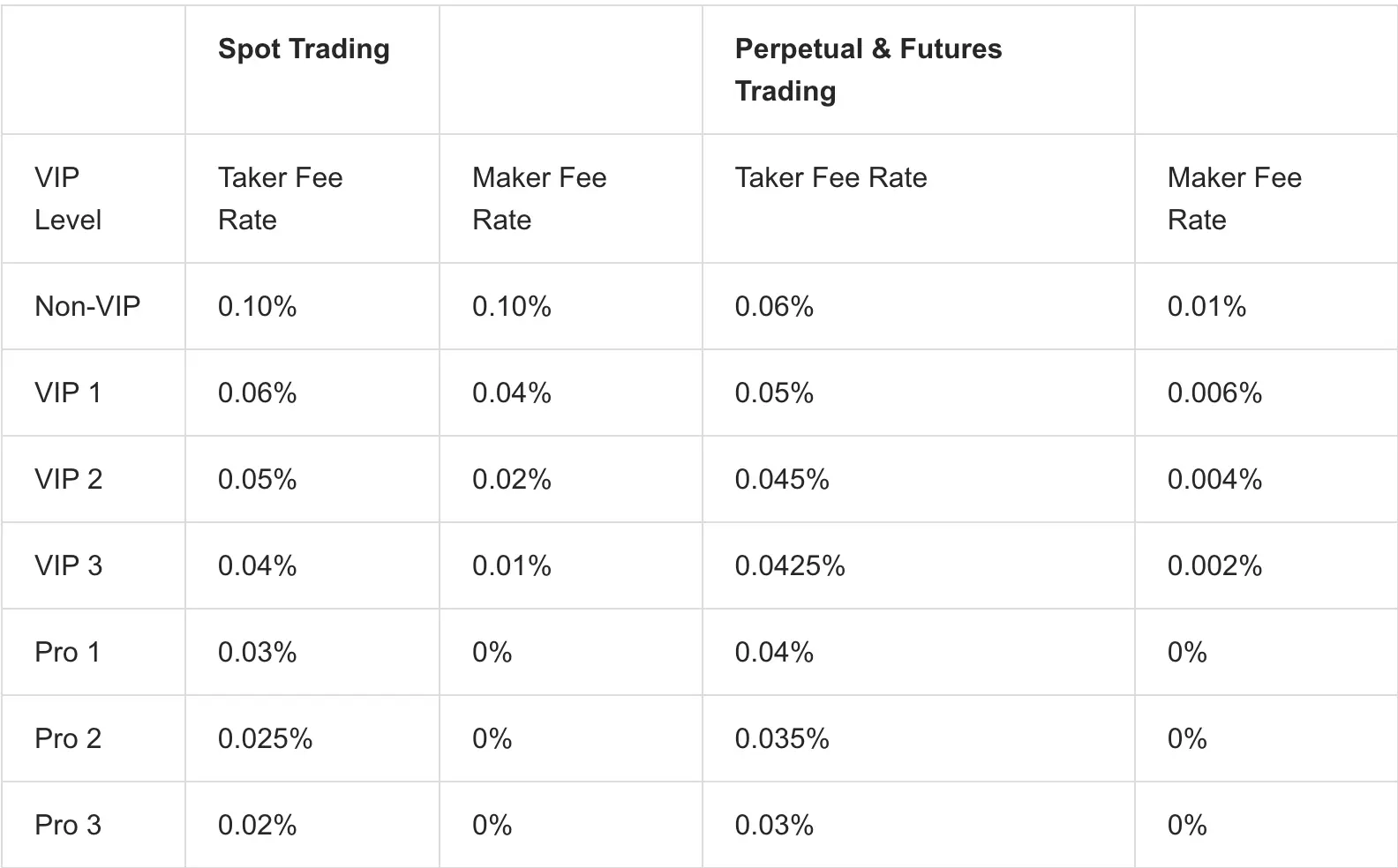
Compared to eToro, Bybit's fee structure is more competitive. Bybit charges a low spot maker fee of 0.10% and a spot taker fee of 0.10%. Additionally, Bybit's futures maker fee is only 0.01% for makers and 0.06% for takers.
Bybit fees
Furthermore, Bybit offers users the opportunity to lower trading their fees for spot, perps, and futures if monthly trade volumes exceed the minimum threshold. Overall, if you are an active trader looking to save on fees, Bybit is the better option between the two. However, if you are beginner who either wants an simpler interface and access to more financial products, eToro is likely to be more suitable.
eToro and Bybit are both cryptocurrency exchanges that offer different deposit methods for their users. Let's take a closer look at what each exchange has to offer.
Starting with eToro, they supports 4 fiat currencies including USD, EUR, GBP, and AUD. Users can make fiat deposits via Bank Transfer, PayPal, Skrill, Neteller, and Credit/Debit Card. The best thing about eToro is that all fiat deposits are free of charge.
On the other hand, Bybit offers support for 5 fiat currencies including USD, RUB, MXN, BRL, ARS, and TRY. Users can make deposits via Bank Transfer, SEPA, FPS, QiWI, Advcash, PIX, and Wire Transfer which incurs an $8 deposit fee.
Bybit fiat deposit
eToro's fiat deposit option are more tailored and beneficial for North American and European users with free support for USD, EUR, and GBP. While Bybit offers USD deposits for a cost, it does not support EUR or GBP.
When it comes to fiat withdrawals, eToro offers two methods, bank account or debit card. When it comes to withdrawals, eToro charges a $5 withdrawal fee and a conversion fee for non-USD currencies.
Compared to eToro, Bybit supports fiat withdrawal for USD, BRL, and TRY. While TRY and BRL bank withdrawals are free, the USD wire transfer fee is quite high at $25. In terms of cryptocurrency withdrawals, Bybit's fees for withdrawing Bitcoin are 0.005 BTC. To withdraw Ethereum and Solana the fees are 0.005 ETH and 0.01 SOL respectively.
In summary, eToro and Bybit are two cryptocurrency exchanges that cater to different types of users. eToro is more suitable for beginners who want exposure to more financial products and helpful products such as demo products where users can trade with fake money and copy trading. In terms of KYC requirements, eToro requires it for all trading on their platform, while Bybit only requires it for certain services.
In terms of trading products, eToro offers a wide range of financial assets to invest in, including 80 cryptocurrencies, but does not offer any spot trading via a traditional orderbook and does not provide leverage.
Bybit offeres over 350 cryptocurrencies and is more geared towards intermediate to experienced traders who are comfortable using a traditional crypto exchange and who want access to advanced features and 100X leverage.
Bybit also offers the comprehensive cryptocurrency trading services, including spot trading, futures, margin trading, perpetual swaps, options, and leveraged tokens, and even includes financial services like lending and borrowing.
In terms of fees, eToro charges a 1% fee for buying and selling cryptocurrencies, while Bybit offers more competitive fees for spot trading which begins at 0.1% for makers andtakers. When it comes to deposit methods, eToro supports 4 fiat currencies (USD, EUR, GBP, AUD) and offers free fiat deposits, while Bybit supports 5 lesser known fiat currencies and offers a wider range of deposit methods to choose from.
eToro USA LLC: Investments are subject to market risk. Including the possible loss of principal.
Author
Jack Moreau
Jack is a crypto writer and reviewer who has been active in the space since he caught the crypto bug in 2017. With a passion for trying out new shiny things, Jack is always eager to try the latest cryptocurrency exchanges, wallets or DeFi applications.